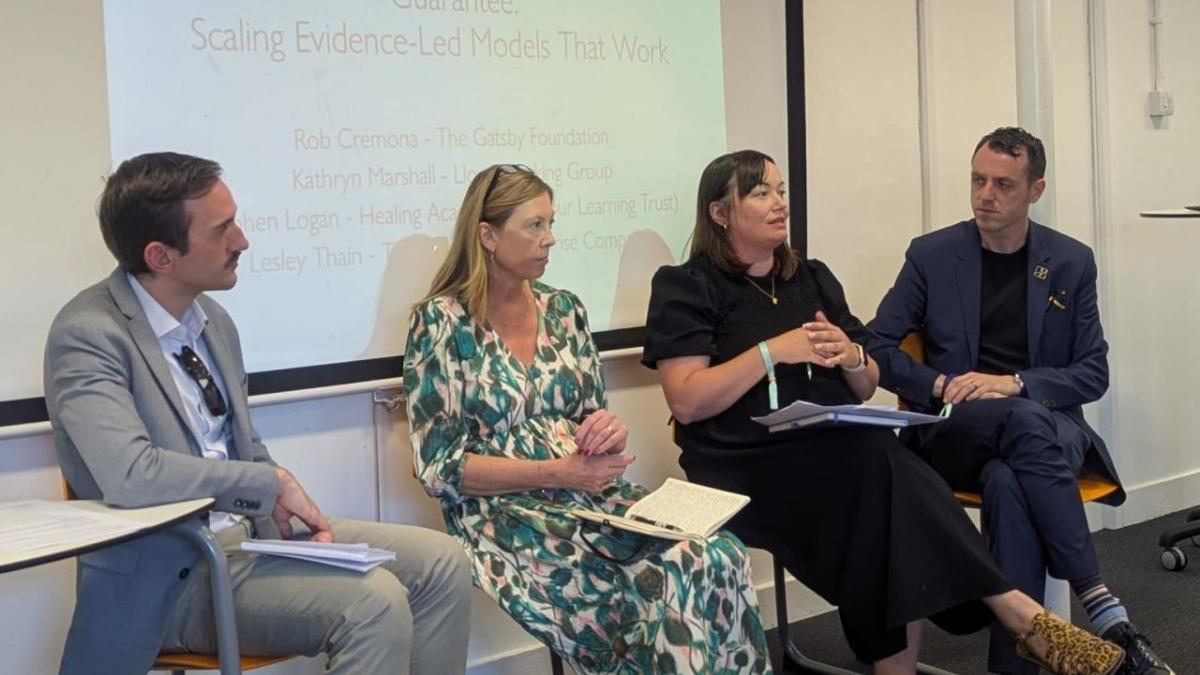
During a thought-provoking session at this year's Festival of Education, speakers came together to share their perspectives on how we can ensure every young person has access to high-quality careers education and meaningful workplace experiences.
Meaningful work experience is about more than a placement.
This session was led by Kathryn Marshall, Senior Next Gen Talent Manager at Lloyds Banking Group and recently appointed Chair of AAN, Stephen Logan, Principal at Healing Academy, Lesley Thain, Head of Education at The Careers & Enterprise Company (CEC) and Rob Cremona, Project Officer at Gatsby.
A key message throughout the discussion was that meaningful work experience cannot be viewed as a standalone activity. Instead, it should form part of a progressive careers programme that helps young people understand the connection between their education and future opportunities.
Rob emphasised that no single intervention can amount to successful careers education. Rather than searching for a "magic bullet", instead, focus on all eight Gatsby Benchmarks as a coherent programme, ensuring work experience builds naturally on earlier careers learning and employer encounters.
The panel agreed that careers education, including work experience, should be valued alongside core curriculum learning. When young people can see how the classroom connects to real jobs, industries and career pathways, they are better equipped to see where education can take them and make informed decisions about their futures.
Start with those facing the greatest barriers
One of the strongest themes to emerge was that the recently updated statutory guidance states that from September 2026, schools should be reforming their work experience programme to deliver two weeks’ worth of work experience from Year 7 to 11 – work experience activities in Key Stage 3 and placement(s) in Key Stage 4.
Stephen Logan shared Healing Academy's approach to ensuring that all students have access to work experience while recognising that different young people require varying levels of support. For students with SEND or those at risk of becoming NEET, meaningful placements rely on careful preparation, strong partnerships, and the removal of barriers before the placement begins.
That preparation extends beyond the careers team. Stephen highlighted the importance of building a whole-school culture of careers, where teachers and leaders understand their role in preparing young people for the workplace. This culture takes time to establish, and he suggested sending educators who are less familiar with careers education to chaperone students, which helps them better understand the purposes of work experience and the industries and opportunities available to their students.
The discussion also highlighted practical examples of employers working with schools to remove barriers. In one case, a business funded transport costs after identifying that travel was preventing students from taking part in placements. These relatively small interventions can make a significant difference to participation.
As Stephen reflected, if work experience is designed to serve the most disadvantaged young people, it is far more likely to serve everyone.
Building confidence earlier
The panel also explored how schools can prepare young people long before work experience begins.
For many students, particularly those without family connections to professional workplaces, entering a work environment for the first time can feel daunting. Kathryn Marshall explained the importance of starting employer engagement earlier through age-appropriate activities that gradually build confidence.
Employer encounters and opportunities to meet apprentices and early-career professionals can help young people see themselves in future roles while making workplaces feel more familiar.
Stephen encouraged schools to use local labour market information to build a "carousel" of career experiences that reflect opportunities within their local economy. By introducing different sectors progressively from Year 7 onwards, schools can help broaden aspirations while making future work experience feel like a natural next step.
Partnerships make the difference
Success depends greatly on strong partnerships between schools, employers and careers organisations.
Kathryn shared valuable insights from an employer's perspective, encouraging schools to plan early, communicate openly and build lasting relationships. She also reminded attendees not to underestimate employers' willingness to help. Sometimes, the simplest question, whether an employer can support more than one student, can unlock additional opportunities.
She also highlighted the value employers place on seeing the impact of their involvement. Publicly recognising employer partners, whether through student or staff feedback on social media or a simple email to say thank you, helps strengthen relationships and encourages continued engagement.
Lesley reflected on the role of Careers Hubs in supporting schools in identifying and building on existing provision rather than starting from scratch. Mapping current activity, understanding local employer networks and prioritising support for the young people who need it most all help create scalable careers programmes that are sustainable over time.
Progress comes through learning
Stephen acknowledged that not every attempt at work experience would be successful. Some involved difficult feedback or required significant changes before they delivered the intended outcomes. However, these experiences became opportunities to learn, improve and strengthen future provision. Headteachers and principals can help by empowering their careers to be innovative and hear examples of good practice from other schools.
This willingness to test new approaches, evaluate what works and adapt over time will be essential in reforming work experience programmes.
Looking ahead
The panel closed with a clear call to action: don't wait for perfect. Students are hungry for the range of benefits that work experience can provide as part of a strong careers education programme.
Meaningful work experience grows through collaboration, persistence and a commitment to continuous improvement. Start early. Build partnerships. Learn from anything that doesn't work first time. Celebrate the employers making a difference. Above all, design opportunities with the most vulnerable young people in mind.
The unifying focus is on ensuring every young person, regardless of background or circumstance, has access to experiences that build confidence, develop skills, and open doors to future opportunities.
Modern work experience
Modern work experience gives every young person access to progressive, high-quality, multiple workplace experiences, throughout their education journey.
Find out more