Education in England is at an inflection point when it comes to preparing young people for adulthood. Over the past decade there has been significant investments in careers education, a renewed ambition for technical excellence, curriculum and assessment reform, employer engagement, post-16 technical reform and enrichment.
This has translated into improved educational participation and attainment and world class qualifications - yet for too many young people doing more of what the system asks of them does not translate into successful progression.
With nearly one million 16-24 year olds now classed as NEET, the challenge facing us now is therefore different. It is no longer simply about how young people achieve in education. It is about how every young person is enabled to progress beyond it.
During 2025-26, I undertook a Churchill Fellowship exploring international approaches to work experience, work connected learning and learner progression in Australia, Canada, Ireland and wider international systems. I began by asking how differentiated work experience could better support young people with different aspirations, interests and circumstances. What I discovered was a much bigger opportunity.
Across every jurisdiction, structures, qualifications and governance, arrangements differed. Yet beneath those differences, a remarkably consistent pattern emerged. These systems recognised that academic success alone does not guarantee successful progression; nor does careers guidance when treated as a separate, standalone activity.
Instead, these systems begin by asking how progression can be intentionally designed around young people, local opportunity and long-term outcomes. Progression becomes an educational outcome in its own right.
Young people do not experience education as a collection of institutions or policy initiatives. They experience a journey. England is highly effective at measuring the principal stations along that journey: primary education, GCSEs, post-16 study, further or higher education and employment. Each institution is assessed against its own responsibilities and outcomes. The space between those stations is less clearly designed.
It is within this space that young people develop confidence, agency and a sense of identity. It is where they encounter employers, test their interests, understand different industries and begin to connect what they learn with who they might become. It is also where pathways can become fragmented, choices can be constrained and young people can lose sight of a meaningful next step.
Responsibility for navigating this space too often rests with young people and their families. Those with access to strong networks, informed guidance and a broad range of experiences are better equipped to make successful transitions. Others reach significant decision points without the same knowledge, confidence, support or opportunity. A powerful convergence of reforms now creates the opportunity to change this.
From Pathways to Progression
International evidence shows that successful progression is not produced by isolated interventions alone. It emerges when curriculum, experience, recognition, partnership and place are intentionally organised around the journey of the learner. My Churchill Fellowship report argues that our focus now should be on creating the conditions that allow purposeful progression to flourish: curriculum flexibility, mature local partnerships, intelligent use of existing qualifications, coordinated delivery across institutions and accountability measures that reward purposeful progression alongside attainment.
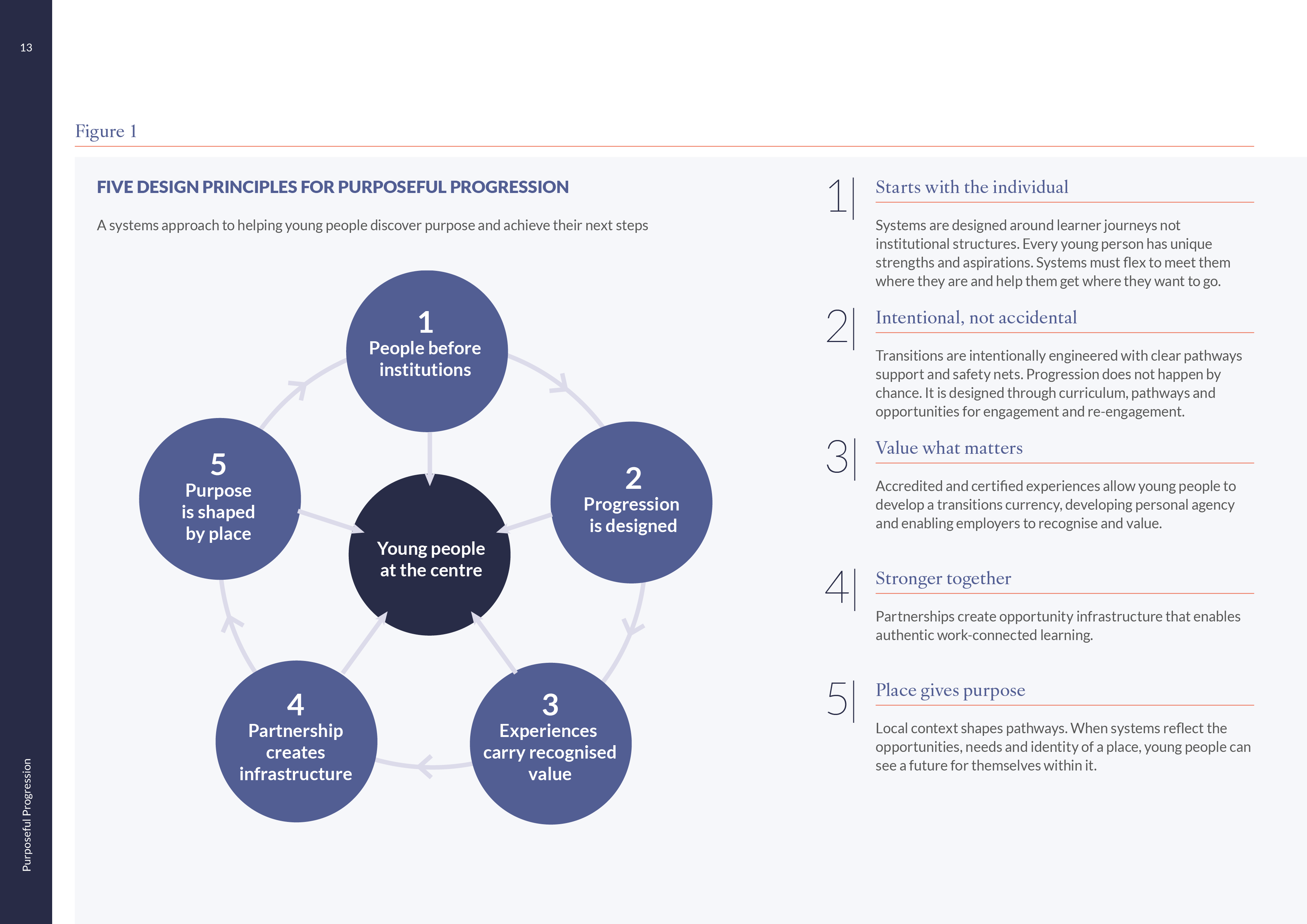
My report proposes five design principles for Purposeful Progression – a systems approach to helping young people discover purpose and achieve their next steps.
New solutions in a time of crisis
Through CEC’s forthcoming Purposeful Progression Co-Mission, we are bringing together young people and sector partners to explore how a 'progression entitlement' can be delivered for every young person. No single organisation can solve this challenge alone. Meaningful pathways into adulthood require collaboration between educators, employers, communities and young people. Every young person deserves to be able to see a future for themselves, and to build towards it and progress with purpose.
Learn more about the Co-Mission: purposefulprogression@careersandenterprise.co.uk.
Read the full report
Purposeful Progression: From Differentiated Work Experience to Work-Connected Learning and Pathways for Every Young Person.
Download here